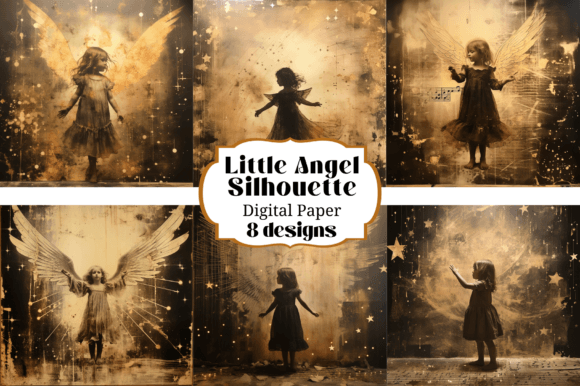
Little Angel Silhouette Backgrounds: A Design Asset for Layered Projects
As a designer or creative professional, I am constantly searching for elements that bridge the gap between spiritual elegance and practical functionality. When I first encountered the Little Angel Silhouette Backgrounds collection, my immediate thought wasn't just about how "pretty" the cherubs looked, but rather how the negative space and distinct shapes could serve as a foundation for complex design work. In a market saturated with flat, uninspired graphics, these eight digital papers offer a distinct personality: they are ethereal yet bold, classic yet versatile. The silhouettes provide a high-contrast visual anchor that commands attention without overwhelming the content layered on top of them.
The visual style of this collection leans heavily into the "Romantic" and "Baroque" aesthetics but with a modern twist. Because these are silhouettes, they function differently than a standard floral pattern. The solid black (or customizable color) shapes against a textured background create a strong visual hierarchy immediately. This is not just a surface pattern; it is a display font for the background layer of your design. The "personality" of these graphics is timeless. They evoke a sense of nostalgia, innocence, and artisanal quality, making them ideal for projects that need to feel handmade or steeped in heritage.
Optimizing File Formats and Resolution for Professional Output
One of the most critical technical aspects of using these assets is understanding the file specifications provided. The collection comes as PNG files at 300 DPI. For the uninitiated, this might just sound like technical jargon, but for a professional, this is the gold standard for print-ready design. Unlike JPEGs, which compress data and lose quality, PNGs support lossless compression. More importantly, PNGs handle transparency and sharp lines exceptionally well. When you are dealing with the crisp edges of a wing or the delicate curve of a halo, you need that pixel-perfect precision.
The 300 DPI (dots per inch) resolution ensures that your files are significantly larger than web-resolution images. This is a massive advantage for editorial design and packaging design. You can scale these backgrounds for large format printing—think posters, book covers, or signage—without the image becoming pixelated or "soft." I always recommend that creators keep their master files in this high resolution and only down-sample to 72 DPI for web usage. This preserves the integrity of the design assets for future projects where high fidelity is required.
Integrating Silhouettes into Brand Identity and Web Design
While scrapbooking and junk journaling are obvious use cases, the true power of Little Angel Silhouette Backgrounds lies in commercial applications like brand identity and web design. In a world dominated by clean, minimalist sans serif font layouts, using a textured, illustrative background can make a brand stand out. Imagine a boutique bakery, a vintage clothing line, or a wellness spa using these silhouettes as a subtle background texture on their website headers. It instantly communicates a specific mood—perhaps "classic," "divine," or "soft"—that aligns with the brand's voice.
When applying these to social media graphics, the silhouettes can act as a "frame" for your typography. If you are using a bold script font or a delicate handwritten font for a quote, placing it over a slightly faded angel silhouette creates a stunning focal point. The key is opacity. By adjusting the transparency of the background layer, you can ensure that your text remains the hero while the angels provide a supportive, atmospheric context. This technique works wonders for Instagram stories, Pinterest pins, and blog headers where visual depth is essential to stopping the scroll.
The Art of Layering: Pairing Typography with Illustrative Backgrounds
Choosing the right typography to pair with a busy or character-rich background is a challenge. You cannot simply throw a complex serif font over a detailed angel silhouette and expect legibility. This is where font pairing becomes a strategic exercise. I recommend using high-contrast typefaces. A heavy, bold sans serif font often works best over these backgrounds because the clean geometry of the letters contrasts with the organic, curved lines of the angels.
However, if you want to lean into the vintage aesthetic, a structured serif font with wide spacing (kerning) can look incredibly sophisticated. The goal is to create a visual hierarchy where the text is readable at a glance. You might also consider placing a semi-transparent shape—like a circle or rectangle—behind your text to separate it from the Little Angel Silhouette Backgrounds. This is a standard technique in modern typography and layout design to ensure that the background enhances rather than competes with the message.
Practical Applications: From Scrapbooks to Commercial Packaging
The versatility of these digital papers is impressive. For the hobbyist, they are perfect for creating custom greeting cards, wedding invitations, or memory-keeping layouts. The "angel" motif is particularly popular for christenings, communions, and sympathy cards, offering a respectful and elegant visual tone. Because the files are labeled and organized in a zip folder, your workflow remains efficient—no digging through chaotic file structures to find the right asset.
For entrepreneurs and small business owners, the applications extend to product packaging. If you are selling artisanal soaps, candles, or jewelry, wrapping your product in a custom-printed tissue paper featuring these silhouettes elevates the unboxing experience. It transforms a generic item into a premium font equivalent in the physical world—a premium product. The cost of digital printing has dropped significantly, making custom patterned packaging accessible even for small batches.
Evaluating Licensing and Project Fit
Before integrating any digital download into a commercial project, it is vital to review the licensing. While these specific files are offered for instant download, you must always verify if the license covers commercial use (selling the end product) or if it is strictly for personal use. Most professional design assets allow for commercial use, but restrictions often apply to "print-on-demand" services where the digital file itself is the primary selling point.
When evaluating the fit for your project, consider the emotional resonance. Does the "angel" motif align with your audience's values? For a tech startup, it might be off-brand, but for a children's book illustrator or a wedding planner, it is a perfect match. Test the backgrounds by mocking up your designs. Do not just place the image on a screen; print a sample if possible. The tactile experience of a printed silhouette often reveals details—like the grain of the background texture—that add significant value to the final product.